28/01/2026 // Sophie Purkischarters
The 2025 season is well and truly over, and the vines are dormant once more; they and we both now wait for warmer weather to awaken them and for the cycle to begin anew. As ever, there is no rest for the wicked – the vineyard team has an entire vineyard to prune back before the new season starts in April. Last year we told you all about the nitty-gritty of pruning; so, this year we thought we’d answer some of the other frequently asked questions related to winter on the vineyard. Starting with the most common question of all…
What does the cold weather do to the vines?
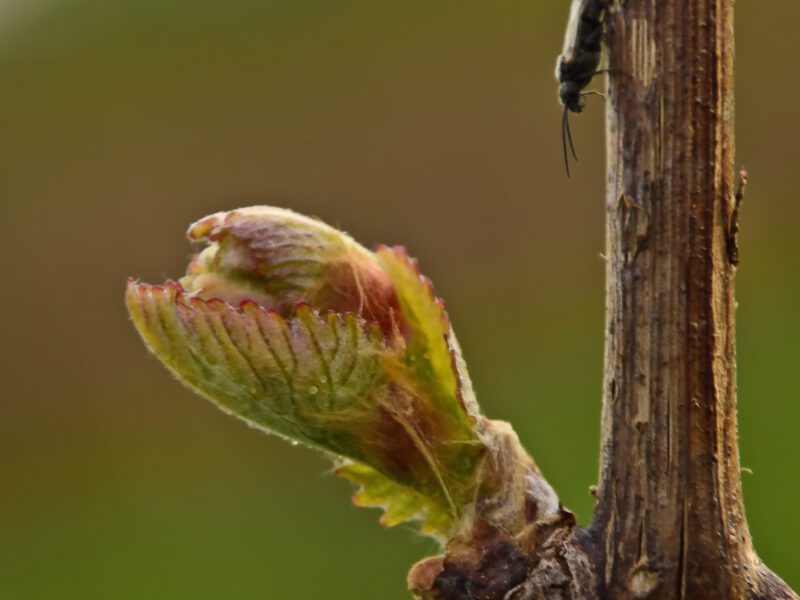
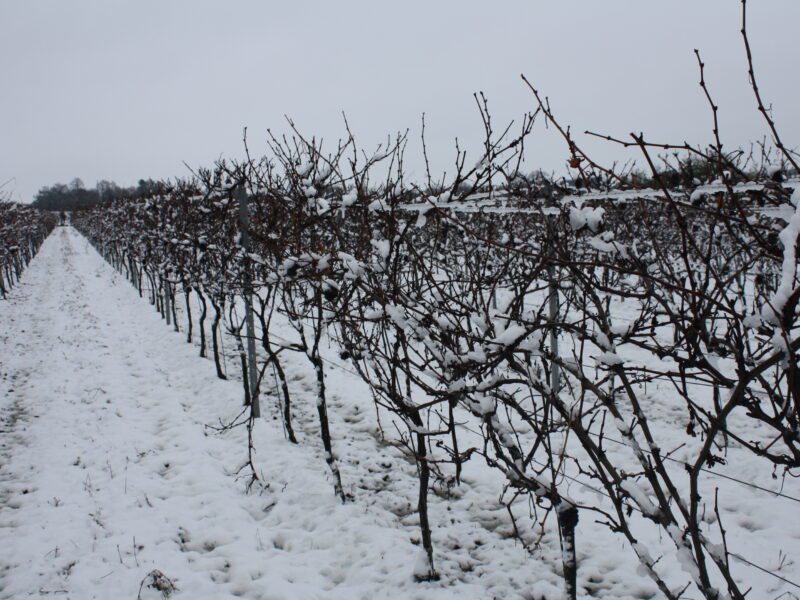
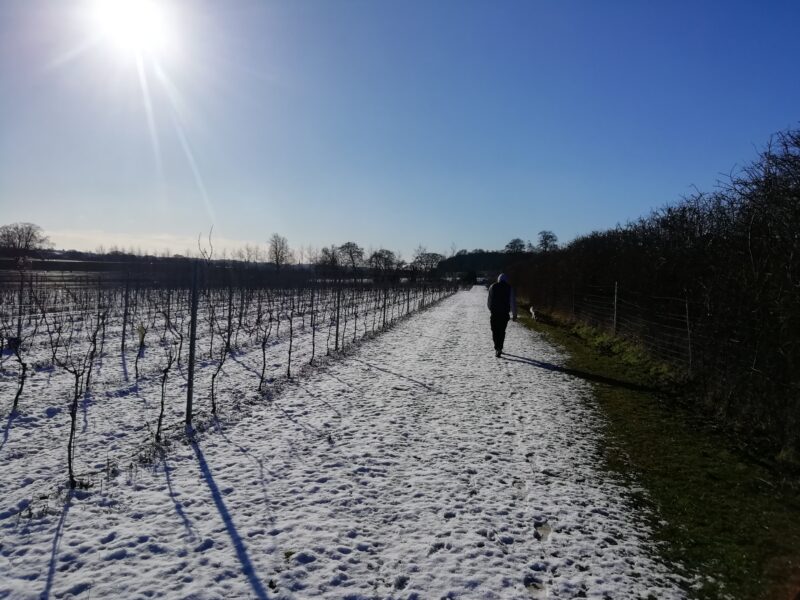
This is a question that we get a lot, often from people who have heard us talk about the dangers of spring frosts and are wondering whether the same is true in winter – especially after cold snaps like the one we have just experienced. The answer to this is surprisingly straightforward: the vines cope just fine with cold weather, down to temperatures of around -20°C depending on the variety. To get a little more technical, vine buds go through different stages of dormancy throughout the year. In autumn, they go into “endodormancy,” which means that they will not burst regardless of ambient temperature.
Then, in early winter, they move into “Eco dormancy,” a state in which they will burst given the right climatic conditions. In this move from endodormancy to Eco dormancy, they go through a process of “acclimation” becoming more and more resistant to cold temperatures. In mid-winter they are at their most cold-hardy. In fact, cold temperatures are vital for our vines. Like most fruit trees, grapevines require a certain number of “chilling hours” between 0 and 10°C, where the grapevine tracks the time spent at lower temperatures to then be able to go through budburst in spring. These chilling hour requirements are generally lower than say apple or pear trees, due to grapevines originating in the Mediterranean, however they are still critically important for ensuring more regular budburst, shoot growth, and bunch development and quality. This is especially the case for sensitive varieties such as Chardonnay!
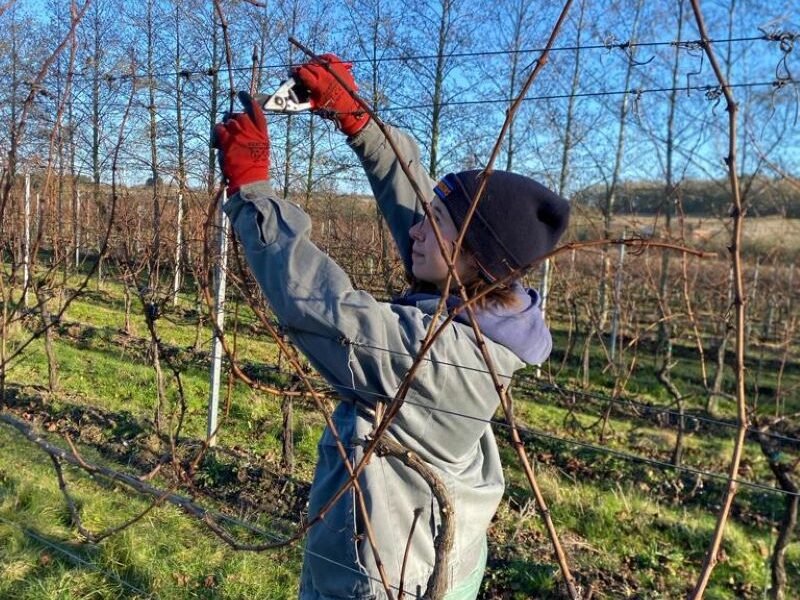
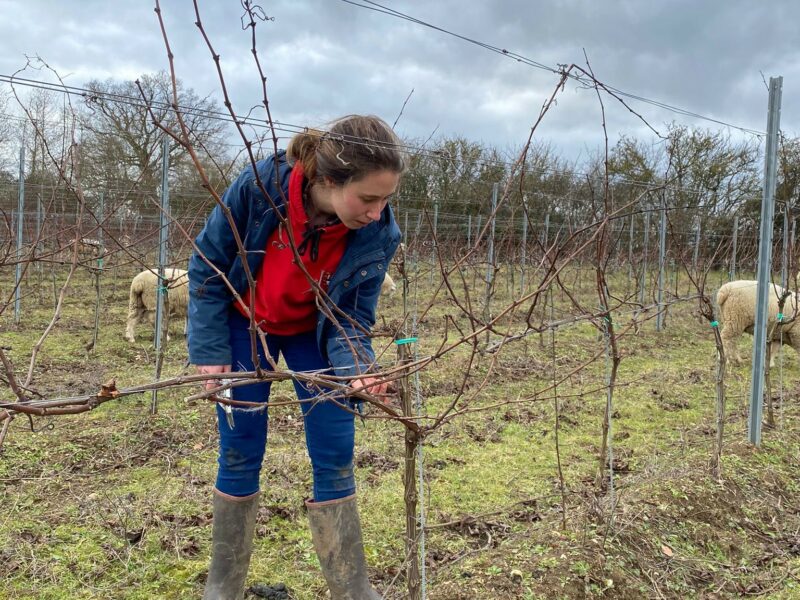
While cold weather is not so bad for the vines, rain and humidity in the winter can be difficult from the point of view of pruning. These conditions favour the development of fungal trunk diseases such as esca, which take advantage of pruning wounds – especially large ones – to colonise vine trunks, eventually killing the vine if they are left to spread. The risk is highest in December, so we usually start pruning in January. It is also why we prefer to prune on a cold but bright and sunny day, rather than a mild, wet one. Luckily, this also coincides with more pleasant conditions for us workers!
All this leads nicely on to our next question…
What do you do between harvest and pruning?
As much as we would like to be out every day communing with the vines, secateurs in hand, other realities often get in the way – sometimes the weather, as above, and sometimes the reality that managing a vineyard is not all about the stuff we do outdoors. At Saffron Grange we use November and December to prepare our annual management meeting in January, when we set out the all-important strategy for the next growing season. The bulk of this preparation involves data collection and analysis, which will allow us to understand our results from the previous year and fine-tune our processes for the next. As a data-driven vineyard, this information helps us answer key questions about our management practices.
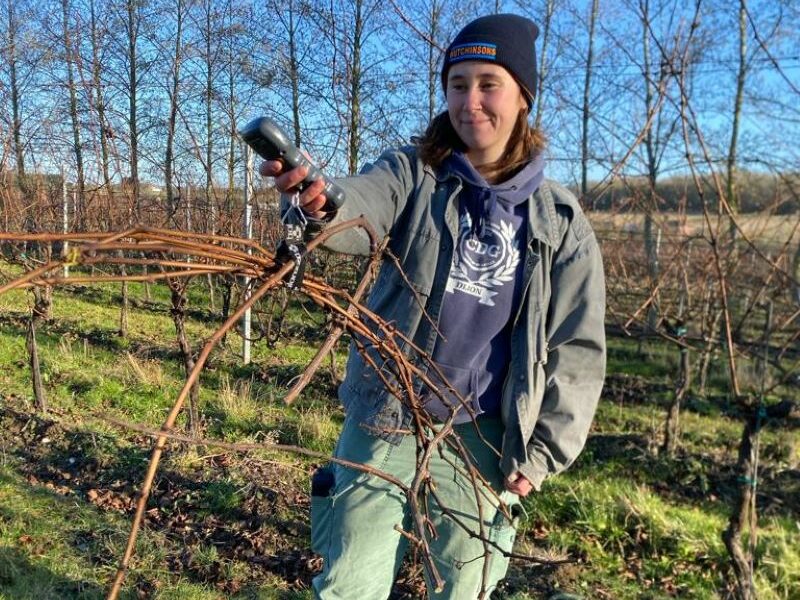
When it comes to pruning, for example, we need to decide how many buds we are going to leave on each cane. Can different blocks support the same amount of yield, or are some more vigorous than others? In order to answer these questions, we look at certain key metrics, mostly related to “pruning weights.” This refers to the weight of all the wood that we take off a sample vine when pruning, weighed with luggage scales. In a healthy vineyard, one would expect pruning weights to either remain constant or increase year-on-year – decreasing weights are the sign of an unhealthy vineyard. We have been seeing increasing weights in almost every vineyard block for the past few years, which is very encouraging!
These weights on their own give us a good indication of the vine’s “vigour,” or ability to produce green growth – but what about the relationship between vigour and yield? To look at this we use a tool called the ‘Ravaz Index’, which is the ratio of yield to pruning weights for the same growing season (the formula for this year, for example, would be Yield in 2025 / Pruning Weight in 2026, all in kg). This gives us a number which, compared to a standard scale, will tell us whether our vines are balanced or not. This is important because it is possible for vines to be overly vigorous; i.e.to be producing too much green growth and not enough yield – just as it is possible for us to be asking too much yield of our vines to the detriment of their vigour.
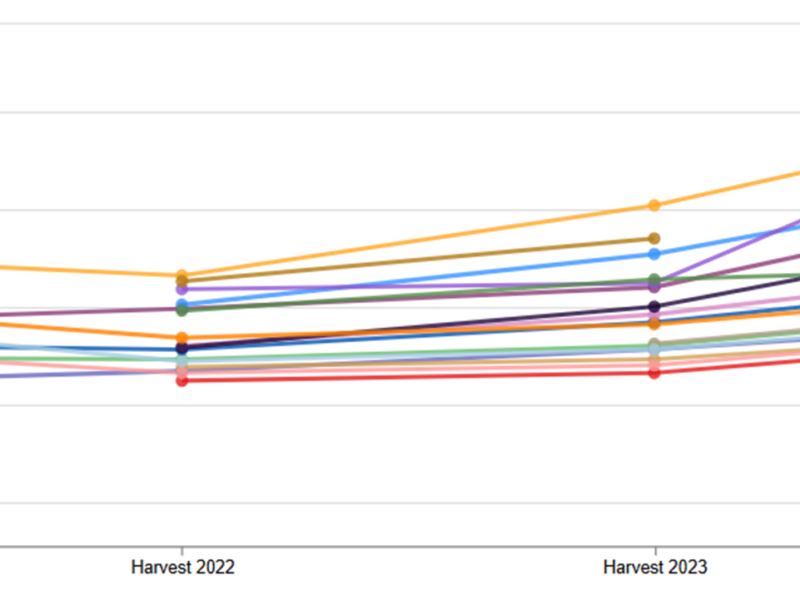
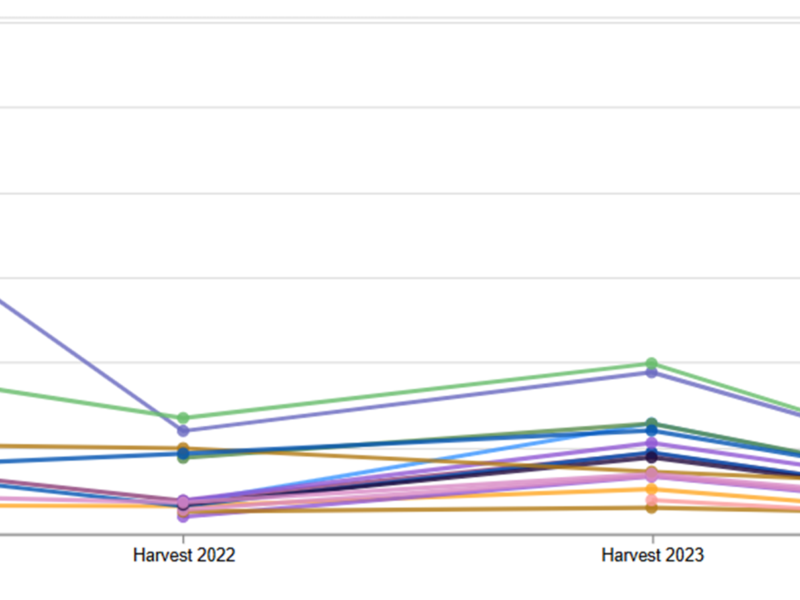
Vigour balanced with yield is the sign of a healthy vine, and that is what we are striving to achieve. All these numbers are input into the data recording software “Sectormentor,” which gives us some digestible colour-coded graphs to look at, such as the graph (above) of pruning weights showing a steady increase over the past four years to 2024.
Or this graph (left) of our Ravaz Index over time, showing some year-on-year differences but a general improvement in homogeneity across the vineyard.
By looking at these trends over time and comparing them to the number of buds that we have left in previous years, we can work out whether we are on the right track or whether we need to adjust our expectations. This allows us to elaborate our pruning plan for the year, as well as strategies for canopy management throughout the season.
As well as looking at standard metrics such as these, we have been running a trial for the past three years looking at the impacts of different “tying-down” methods in the vineyard. Tying-down is the task that comes immediately after pruning and disposing of the pruning wood; about half of our vines are pruned in the guyot or cane-pruning style, which means that each year we end up with an upright cane which must be tied to the trellis wire in order that the next year’s shoots might also grow vertically. This can be done in several ways – horizontally along the wire, as is traditional, or in the “Pendelbogen” style which curves up and around a top fruiting wire and is then attached to a lower fruiting wire at the end. We have also been experimenting with tying down before budburst, as is usual, and after frost season, in early June, looking at the impact of these methods on frost damage, vigour metrics, and yield. Once the analysis of the results is complete, we will be able to start implementing what we have learned and improve our management practices.
With most of this analysis out of the way, we can now make the most of any good weather to focus on pruning – and the variety of other tasks that must be attended to before spring.
So if you’re not pruning while it’s raining… what are you doing?
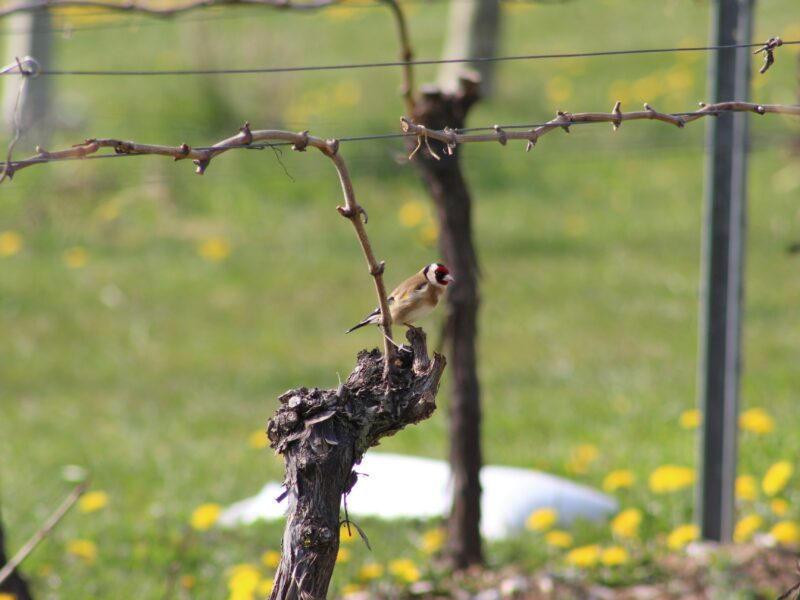
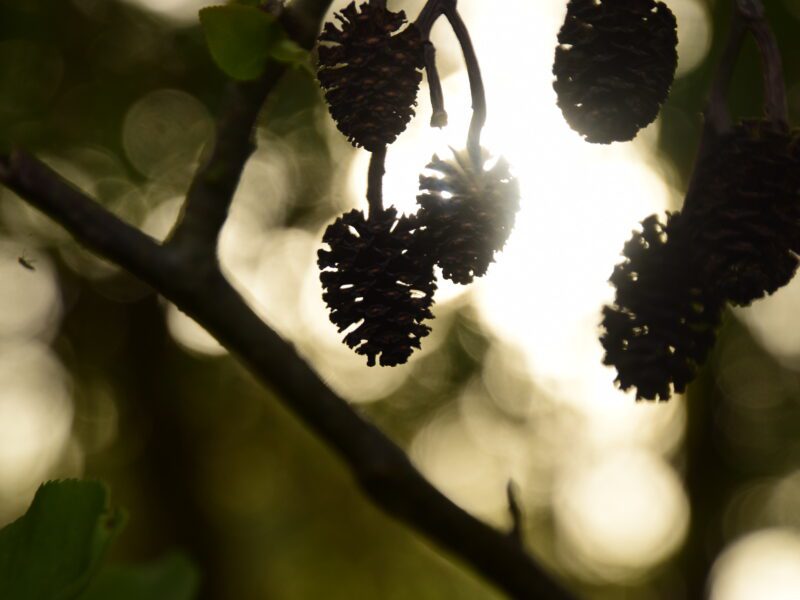
While Saffron Grange is first and foremost a working vineyard, the space around the vines is just as important. From the meadow at the entrance of the site, to the plants that grow between and around our vines, we have a variety of “non-productive” areas which provide services to the vineyard. Our wildflower patches, full of oxeye daisies, poppies, and scabious, provide habitat to pollinators which enhance the biodiversity of our site. Our hedgerows, which surround the vineyard, and our lines of alder trees which have been planted between each field, not only act as a home for numerous bird species (think goldfinches, siskins, and yellowhammers), but crucially have been designed as windbreaks for our vines, protecting them from the strong winds that blow through what is an otherwise very exposed site.
However, as managers of this space, we must strike a balance between the benefits that they provide and their potential drawbacks. This is particularly the case in relation to spring frosts, which occur from early April to early June when the buds have burst on our vines and the green tissue is vulnerable to temperatures below 0°C. As cold air sinks overnight, it pools near our buds – at a height of around 1m from the ground which leads to damaged shoots and a loss of yield – sometimes significant. This cold air flows rather like molasses; as it seeps down our gentle slope, any obstacle it encounters will slow its progress and exacerbate the pooling effect. This means that the meadow at the bottom of the vineyard needs mowing, so that the long grass and flowers left over from last season do not act as barriers to the frost. Of course, this is not a task we can undertake during such wet weather – we often enlist the help of our resident sheep to give us a hand with this until drier conditions allow us to get on the tractor. In previous years they have done a good job keeping down the grass in our vineyard rows, which would cause much the same problem. Having sheep in the vineyard also has benefits for the soil, improving the relationship of our alleyway plant species with soil microbiota as well as reducing our need for artificial fertilisers.
Another frost-related task that needs attention is the maintenance of our alder trees in the vineyard. Over the past two years we have topped those in the middle of the vineyard to bring down their height and mitigate shading of the vines as well as crown-lifting them, removing branches up to 3m from the ground, to allow the cold air free passage underneath and some airflow in the growing months to assist with reducing humidity and fungal disease pressure. We have hope that in the event of a frost similar in scale to last year’s -2.5°C, this will be another aid in our defenses.
Also, on those rainy days this winter, we will be undertaking hedgerow management in the form of bramble clearing and cutting back. We operate a three yearly cycle of flailing our hedgerows to allow for increased habitats for all the tree, plant, grasses, mosses, fungi, invertebrates, mammals and birds that these ecosystems support. However, within that three yearly cycle there is tidying up and management to be done especially with such an invasive species like bramble or ivy. And although these do provide good habitats and food sources, they also require a trim quite often to ensure they do not take over to the detriment to the hedge. A job that requires a thick coat, a thick pair of trousers and a decent pair of gloves!
As well as shoring up our defenses to ensure that next year’s growing season gets off to a good start, this winter we will be taking positive steps in our journey towards producing our own compost to use on the vineyard. With a huge volume of organic matter coming off the vineyard each year, in the form of pruning wood, grape skins and seeds, we need to ensure that we are adding back where we can, so that the soil is not depleted of its nutrients. While in 2023 we brought in compost to compensate for this, what we really want is a closed-loop system, using our own organic matter. This is an inherently experimental process! We are looking into Johnson-Su bioreactors, which supercharge the composting process by providing the ideal conditions for soil life and in particular fungi, which are so crucial to our vines’ ability to extract nutrients from the soil. We have just started a ‘windrow system’, which will allow us to deal with the ever-increasing volume of organic matter which comes from our maturing and expanding vineyard.
Thankfully, these are all tasks which can be carried out in wetter weather, meaning that we can make the most of our pruning down-time to carry out some exciting improvements on site. Hopefully, this has answered some of your burning questions relating to our winter operations on the vineyard. While the weather remains largely on our side for now, as it becomes milder and wetter, we will have to be increasingly adaptable on the vineyard in order to finish pruning our vines before spring arrives – and the new cycle begins.